Sustainability language shows up in RFQs now in a way it didn’t ten years ago. OEMs want to know what percentage of a housing can be reclaimed, whether a bracket can go back into the same product line and what happens to the part after the customer is finished with it. The short answer is that most injection molded parts are recyclable in principle. The longer answer is that recyclability gets decided at the resin selection meeting, not at the curb.
Plastic injection molding produces parts from thermoplastic resin, and thermoplastics can be melted and reformed repeatedly. That property is what makes recycling possible at all. What complicates things is everything that gets added along the way: glass fiber, flame retardants, pigments, adhesives, metal inserts and second-shot overmolds. Each addition narrows the range of things a recycler can do with the part when it comes back.
Thermoplastics Reform Under Heat, Thermosets Do Not
The split between recyclable and non-recyclable plastic starts with polymer chemistry.
Thermoplastic resins soften when heated and harden when cooled, and the cycle repeats without a chemical reaction taking place. Polypropylene, polyethylene, ABS, polycarbonate and nylon all behave this way. A finished part can be ground into flake, melted and molded into something else. Nearly all commercial injection molding runs thermoplastics for exactly this reason, since the process itself depends on the resin flowing under heat and setting in the mold.
Thermosets cure through an irreversible crosslinking reaction. Once an epoxy or phenolic part sets, heating it again degrades it rather than softening it. Conventional mechanical recycling doesn’t work on thermosets. They’re usually ground into filler material or sent to energy recovery.
So the first question about any molded part is which family the resin belongs to. For most parts coming out of a plastic injection molding cell, the answer points toward recyclable.
Common Molding Resins and Their Recycling Outlook
| Resin Code | Resin | Typical Molded Applications | Recycling Notes |
|---|---|---|---|
| 1 (PET) | Polyethylene terephthalate | Preforms, jars, rigid containers | Collected widely, though most volume goes into fiber rather than back into containers |
| 2 (HDPE) | High-density polyethylene | Crates, caps, totes, housings | Strong recycling infrastructure, holds properties well through reprocessing |
| 5 (PP) | Polypropylene | Closures, automotive trim, appliance components | Growing collection rates, good heat resistance in second life |
| 7 (ABS) | Acrylonitrile butadiene styrene | Electronics enclosures, consumer housings | Recyclable through industrial channels, rarely collected curbside |
| 7 (PC) | Polycarbonate | Lenses, structural housings, medical components | Recyclable but sensitive to heat history and moisture |
| 7 (PA) | Nylon | Gears, connectors, under-hood parts | Recyclable, though glass-filled grades limit the options |
Four Variables Decide Whether an Injection Molded Part Actually Gets Recycled
Material chemistry sets the ceiling. These four factors determine how close a part comes to it.
Contamination. Food residue, oils, adhesive labels and mixed resin streams degrade the quality of reclaimed material. A polypropylene tub with a polyethylene label and a metal handle isn’t one recyclable item, it’s three materials a recycler has to separate before any of it has value.
Fillers and reinforcement. Glass fiber changes what reclaimed resin can do. Fibers break down and shorten during grinding and reprocessing, so a 30 percent glass-filled nylon loses stiffness through each cycle. Reclaimed filled material usually gets downcycled into lower-demand applications rather than returning to the original part.
Pigments and additives. Carbon black is the well-known problem. Near-infrared sorting equipment identifies resin by how it reflects light, and carbon black absorbs the signal, so black parts often pass through automated sorting unrecognized and end up in residue. Flame retardants, UV stabilizers and impact modifiers all narrow the applications a reclaimed pellet can serve.
Assembly and joining method. Overmolded TPE grips, ultrasonically welded seams, heat-staked metal inserts and adhesive bonds all mix materials in ways a shredder can’t undo. Parts that come apart cleanly recycle. Parts that don’t get landfilled.
Recyclers Convert Used Parts Into Pellets in Seven Stages
Post-consumer material follows a fairly consistent industrial path from bin to new resin.
- Collection. Curbside programs, drop-off sites and commercial waste contracts gather rigid plastic. Industrial and manufacturing scrap enters through separate commercial channels.
- Transport to a materials recovery facility. Mixed recyclables arrive at an MRF for the first round of separation.
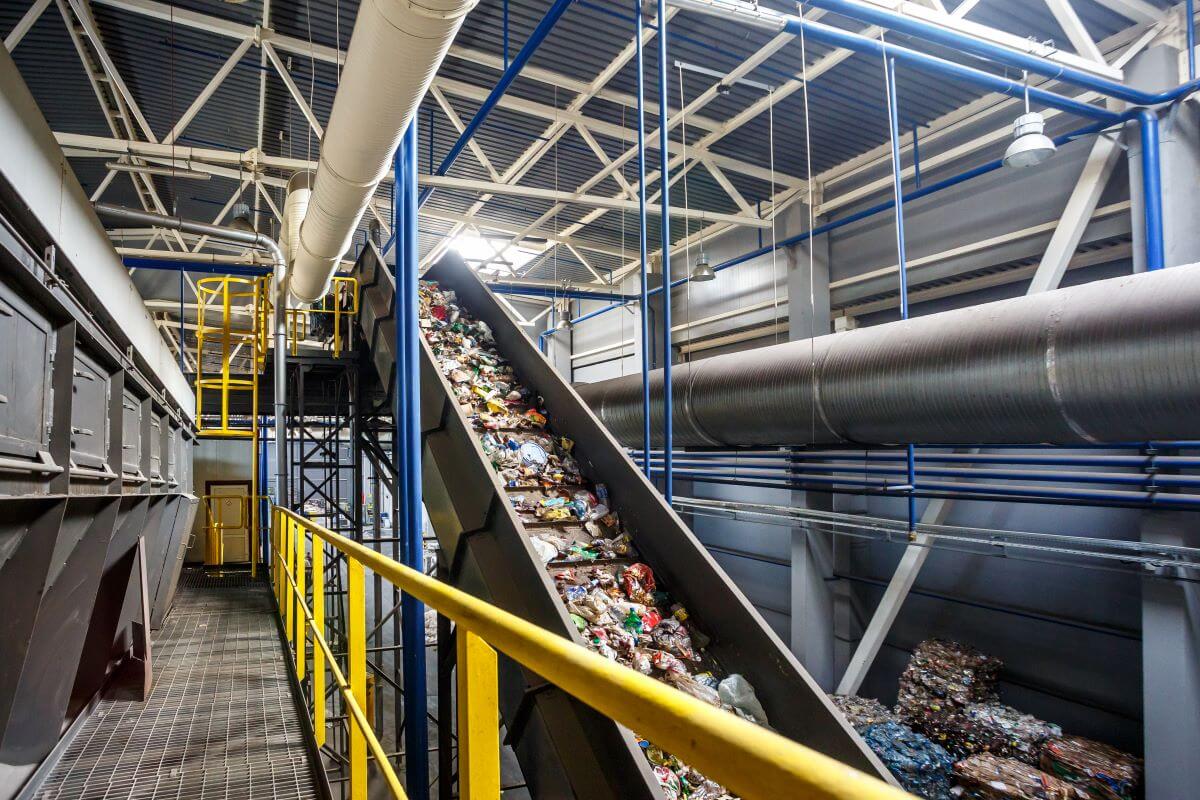
- Sorting. Manual pickers pull obvious contamination. Automated equipment takes over from there: near-infrared spectroscopy identifies resin type, optical sensors separate by color and air jets divert each stream onto its own belt. Sorted material gets baled by resin.
- Size reduction. Bales go to a reprocessor, where granulators chop material into flake. Smaller pieces expose more surface area for washing.
- Washing and density separation. Hot water and detergent remove residue, glue and label stock. Float-sink tanks then separate resins by density, since polypropylene and polyethylene float while PET and PVC sink.
- Drying. Centrifugal dryers pull moisture out of the flake. Residual moisture causes hydrolytic degradation and splay during the melt stage, so this step is not optional for engineering resins.
- Extrusion and pelletizing. Clean flake feeds into an extruder, passes through a filter screen that catches remaining contaminants, exits a die as strands and gets cut into pellets. The output is post-consumer resin, or PCR, and it looks essentially like virgin material.
Those pellets then go back to molders, usually blended with virgin resin at a validated ratio rather than run at 100 percent.
Injection Molders Reclaim Scrap Before It Ever Leaves the Building
The recycling most relevant to an OEM’s part number happens inside the molding facility, not at a municipal recovery center.
Every molding cycle produces material that isn’t a finished part: sprues, runners, purge, startup shots and rejected pieces. In a conventional cold-runner tool, runners alone can account for a meaningful share of shot weight. Granulators positioned at the press grind this material into regrind, which gets blended back into the feed at a controlled ratio.
Regrind carries real advantages. The material never left the plant, so its identity is certain, its contamination risk is close to zero and its process history is documented. That’s post-industrial resin, or PIR, and it’s the cleanest recycled feedstock available.
It also carries limits. Every heat cycle shortens polymer chains and reduces molecular weight. Melt flow index climbs, impact strength drops and color shifts. Most programs cap regrind between 10 and 30 percent depending on resin and application, and the ratio has to be validated rather than assumed. A part qualified at 20 percent regrind is not automatically qualified at 40 percent.
Hot runner tooling changes the math further by eliminating the runner entirely. Higher tooling cost up front, less scrap to reclaim for the life of the program.
Recycled Content Starts With the Molding Partner
The most effective point to influence whether a molded part gets recycled is the design review.
- Consolidate to a single resin family. A housing, a clip and a cover in the same polymer recycle as one stream. Three different polymers recycle as none.
- Mold in the resin identification code. Adding the code to the tool costs nothing per part and tells any downstream handler what the material is.
- Choose snap fits over adhesives. Mechanical fasteners and snap features allow disassembly. Adhesive bonds and ultrasonic welds don’t.
- Reconsider carbon black. Where appearance allows, NIR-detectable pigments keep the part visible to automated sorting.
- Question filler content. If a glass-filled grade is being specified for a property the design could achieve through ribbing or wall optimization, the unfilled resin recycles better.
- Reduce insert count. Metal inserts add contamination and separation cost. Molded-in threads or self-tapping fasteners avoid the problem.
None of these tradeoffs are free, and some conflict with performance requirements. They’re worth raising during design for manufacturability review, when changes are still inexpensive.
Frequently Asked Questions About Recycling Injection Molded Parts
Is all injection molded plastic recyclable?
No. Thermoplastic parts are recyclable in principle because the resin remelts. Thermoset parts are not, since curing creates an irreversible chemical bond. Contamination, fillers and mixed-material assembly can make a technically recyclable thermoplastic part impractical to recycle.
What is the difference between regrind and post-consumer resin?
Regrind, also called post-industrial resin, is scrap reclaimed inside the molding facility from sprues, runners and rejected shots. Post-consumer resin comes from products that reached an end user and returned through collection programs. Regrind has known history and lower contamination risk. PCR does not.
How much regrind can be used in a molded part?
Most programs run between 10 and 30 percent, depending on the resin and the application requirements. Each melt cycle degrades polymer chains, so the ratio has to be validated against the part’s mechanical and dimensional specifications rather than set by default.
Why do black plastic parts get rejected by recycling facilities?
Automated sorting relies on near-infrared spectroscopy, and carbon black pigment absorbs the infrared signal instead of reflecting it. The sorter can’t identify the resin, so the part is routed to residue even when the underlying material is fully recyclable.
Recycled Content Starts With the Molding Partner
Recyclability isn’t a property a part either has or lacks. It’s the outcome of resin selection, tooling strategy, assembly method and quality requirements, and most of those get locked in early.
KS Group has been running custom plastic injection molding for more than 50 years across facilities in San Leandro, California and Tijuana, Mexico. Our engineering team works through resin selection, regrind strategy and design for manufacturability with OEM programs in electronics, agriculture, transportation and consumer products.
Contact KS Group to discuss material strategy and recycled content for your next program.