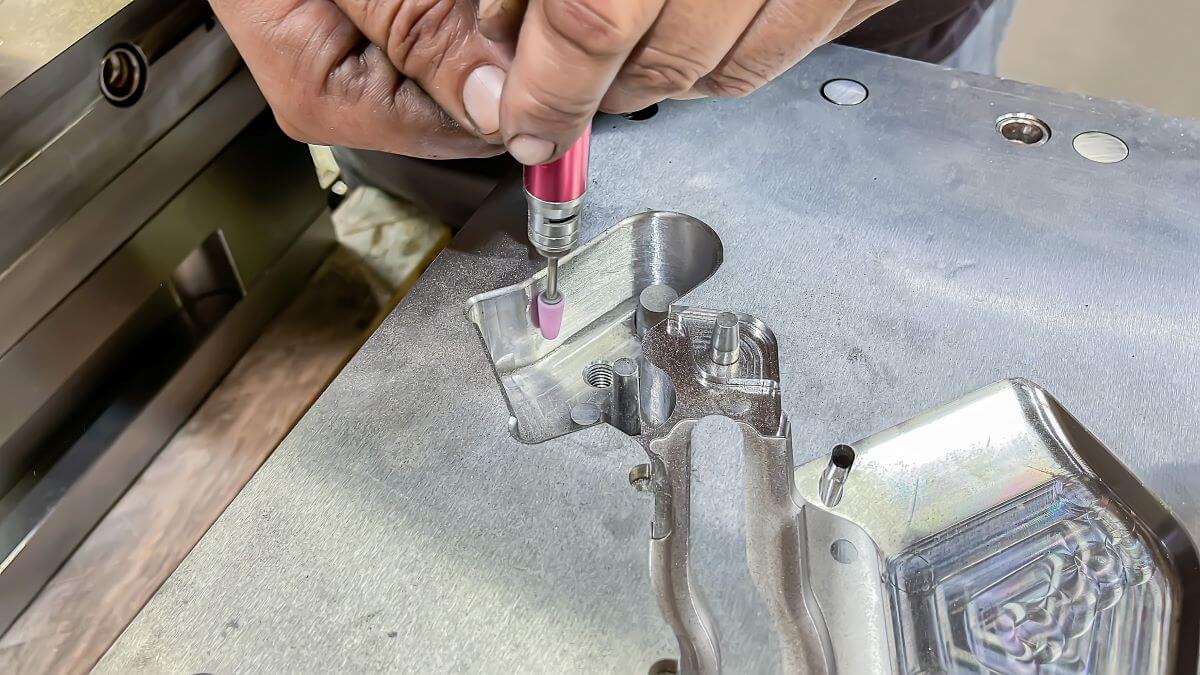
Every production cycle subjects an injection mold to extreme pressure, thermal stress, and mechanical wear. Over thousands or millions of cycles, cavities erode, cooling channels clog, ejector pins wear, and parting lines drift. These are predictable, well-understood consequences of how the molding process works, which is exactly why mold maintenance deserves to be treated as a core part of production planning rather than something addressed only when problems surface.
In plastic injection molding, the condition of the tool has a direct bearing on the quality of every part it produces. A properly maintained mold runs at predictable cycle times, holds dimensional consistency across long production runs, and reaches its rated tool life without requiring major intervention. This article covers what mold maintenance involves, why it matters at every stage of a program, and what a well-structured maintenance program looks like in practice.
What Mold Maintenance Covers in Plastic Injection Molding
Mold maintenance encompasses everything required to keep a tool performing at spec across its production life, and most programs organize that work into two distinct categories based on when and why the work is performed.
Preventative maintenance (PM) is performed on a scheduled basis and typically includes cleaning parting lines and cavities, inspecting and lubricating ejector pins and guide pins, checking water lines and hot runner systems for flow restriction or leaks, replacing consumable components on a cycle-count basis, and documenting the condition of the tool at each service interval. The work happens on a schedule that production can plan around, and its value lies in catching wear before it becomes a defect or a failure.
Corrective maintenance addresses problems that have already appeared, such as a broken ejector pin, a damaged cavity surface, worn leader bushings, or a hot runner tip that has begun to degrade. This type of work requires pulling the tool from the press and halting production until repairs are complete, which is why the underlying goal of any maintenance program is to keep the ratio of preventative to corrective work as high as possible.
How Mold Condition Affects Part Quality in Injection Molding
Several of the most common defects in plastic injection molding trace directly to maintenance issues, and understanding how mold condition produces specific part problems makes it easier to diagnose root causes and prioritize service activities.
Flash
Flash occurs when plastic escapes the cavity at the parting line, leaving thin fins of material on the finished part. Worn or contaminated parting line surfaces allow melt to escape under injection pressure, and if the condition is not corrected, flash creates downstream problems in assembly and can generate sorting costs or customer returns that far exceed the cost of routine parting line maintenance.
Sink Marks and Warpage
Sink marks and warpage often originate from degraded cooling performance. Scale and debris accumulate inside water channels over time, reducing heat transfer and causing the mold to run hotter than the process parameters assume. The resulting uneven cooling produces dimensional instability in the part, and flushing cooling circuits on a defined schedule both prevents this from developing and frequently recovers cycle time that has been quietly lost to thermal creep.
Surface Defects and Cosmetic Variation
Surface defects and cosmetic variation worsen as cavity surfaces accumulate resin deposits or experience wear. Gas trapping, discoloration, and increased flow-line visibility are all sensitive to cavity wall condition, and for programs with tight cosmetic requirements, the cleaning frequency for cavity surfaces needs to be treated as a process parameter in its own right.
Ejection Problems
Ejection problems including stuck parts, drag marks, and part distortion typically trace to ejector pins that have worn, galled, or lost adequate lubrication. When pins create inconsistent ejection forces, the effect is felt both in the part and in the mold structure itself, making ejector pin inspection and lubrication one of the higher-value activities in any routine PM program.
The Cost of Skipping Preventative Mold Maintenance
Production-grade injection molds represent a substantial capital investment, ranging from tens of thousands to well over $100,000 depending on complexity, cavity count, and material, and the decisions made around maintenance determine how much productive life that investment actually delivers.
The most immediate consequence of deferred maintenance is unplanned downtime. When a mold fails mid-run, the tool has to be pulled from the press, assessed, repaired, and requalified before production can resume, a process that can take days or weeks depending on the severity of the damage and the availability of repair resources. Scheduled maintenance events, by contrast, can be planned around production commitments and staffed appropriately in advance.
Beyond stoppage events, there are costs that accumulate more gradually and are often harder to attribute. Increased scrap and rework rates, higher reject percentages at first article inspection, longer cycle times from degraded cooling performance, and the labor involved in sorting borderline parts all represent real financial impact that rarely shows up against the maintenance budget. When those costs are tracked and totaled, the return on proactive PM spend becomes straightforward to justify.
Tool longevity is the third dimension of maintenance value. A mold that is consistently serviced can run for hundreds of thousands to millions of cycles and reach its rated tool life. One that is maintained reactively will require major rework or full replacement earlier than planned, turning a manageable operating expense into an unbudgeted capital cost.
What a Strong Injection Mold Maintenance Program Looks Like
The tasks that make up mold maintenance are well understood across the industry. Cleaning, lubrication, inspection, component replacement on a defined schedule, and proper storage are all established practice. What distinguishes programs that perform well over time is whether those tasks are executed consistently and whether the results are documented in a way that informs future decisions.
Cycle-Based Scheduling
Maintenance intervals are most meaningful when tied to shot counts rather than calendar time, since a mold running three shifts accumulates cycles at a very different rate than one running a single shift. Most programs define multiple service tiers, with lighter tasks such as parting line cleaning triggered at shorter intervals and full disassembly with deep inspection scheduled at longer ones, so that maintenance frequency scales accurately with actual tool usage.
Documentation and Traceability
A mold logbook that records service dates, cycle counts at the time of service, tasks performed, components replaced, and any anomalies observed creates the foundation for increasingly intelligent maintenance decisions over time. Patterns that would otherwise go unnoticed become visible in the data: a particular ejector pin that tends to wear at a predictable interval, a cavity surface that requires more frequent cleaning when running a specific resin, or a cooling circuit that shows signs of restriction earlier than expected. That kind of accumulated knowledge makes future maintenance more targeted and the overall program more cost-effective.
In-Process Maintenance
Parting line cleaning, visual inspections, and minor lubrication can often be performed between cycles or at shift changes without pulling the tool from the press. Molders who build these tasks into standard operating procedures are able to catch early signs of wear before they develop into defects and extend the interval between full PM events, which has a compounding effect on program efficiency over time.
Proper Storage
Molds that are not in active production should be stored clean, dry, lubricated, and with plates separated to prevent moisture from becoming trapped against steel surfaces. Corrosion inside cooling channels and on cavity surfaces develops during storage when conditions are not controlled, and a mold that requires corrective work before it can run again adds unplanned cost and lead time to any program restart.
How to Choose a Plastic Injection Molding Partner With Proven Maintenance Practices
For companies that outsource injection molding, mold maintenance is largely invisible. The tool lives at the molder’s facility, and unless the molder has transparent documentation practices, customers rarely have insight into how their tooling is being maintained between production runs. Evaluating maintenance practices during supplier selection is one of the more underutilized steps in establishing a reliable long-term program.
When assessing a potential molding partner, ask specifically about how molds are maintained. Look for documented PM schedules tied to shot counts, mold logbooks that record every service event, a dedicated maintenance team or in-house toolroom with qualified personnel, and clear protocols for communicating maintenance findings that affect production planning. A molder that can answer these questions with specifics and documentation is one that is managing tooling as a long-term asset with measurable consequences for part quality and program continuity.
KS Manufacturing maintains structured injection mold maintenance programs across its facilities, with every tool tracked, documented, and serviced on a defined schedule. Customers who bring programs to KS benefit from that discipline across the full production life of their tooling.
Mold Maintenance Is a Plastic Injection Molding Production Strategy
The financial case for preventative mold maintenance is straightforward when the full picture is visible. PM spend shows up as a line item; the scrap rates, sorting labor, unplanned downtime, and shortened tool life that it prevents are distributed across other budget categories or absorbed as normal cost of production. Bringing those numbers together typically makes the value of a disciplined maintenance program easy to see.
For programs running at volume with consistent quality requirements, mold maintenance is a production strategy with direct consequences for part quality, schedule reliability, and the total cost of the program over its lifetime. Molders who treat it that way build tools that run longer, produce fewer defects, and deliver more predictable output from the first run through the last.
Schedule a Plastic Injection Molding Consultation With KS Manufacturing
KS Manufacturing maintains structured mold maintenance programs across its San Leandro and Tijuana facilities, with every tool tracked, documented, and serviced on a defined schedule tied to shot counts. Whether you are transferring an existing program or building a new one from the ground up, our team can walk you through how we protect tooling investments and keep production running consistently over the life of a program. Contact us to schedule a consultation and discuss what a well-maintained injection molding program looks like for your parts.